
Comment nettoyer et entretenir les poignées en liège de vos bâtons de randonnée (sans en altérer la sensation)
Si vous randonnez pendant un été chaud ou une intersaison boueuse, vos poignées en liège fonceront. Cette patine est normale et, pour beaucoup d'entre nous, elle fait partie de leur charme. L'astuce consiste à les garder propres et adhérentes sans les dessécher ni altérer la colle sous le liège. Voici la routine simple que nous utilisons pour nos propres bâtons (très similaire à celle employée par les pêcheurs pour l'entretien des poignées en liège de leurs cannes à pêche).
Ce dont vous aurez besoin
- Chiffon doux ou serviette en microfibre
- Liquide vaisselle doux + eau tiède (un petit bol)
- Brosse douce ou éponge « magique » en mélamine
- En option : papier de verre grain 400–600 (uniquement pour les taches tenaces).
- En option : mastic de liège (pour les trous) et un fin joint de liège (à base de polymère).
- Cotons-tiges / cure-dents pour les coutures serrées
Soins rapides après la randonnée (30 secondes)
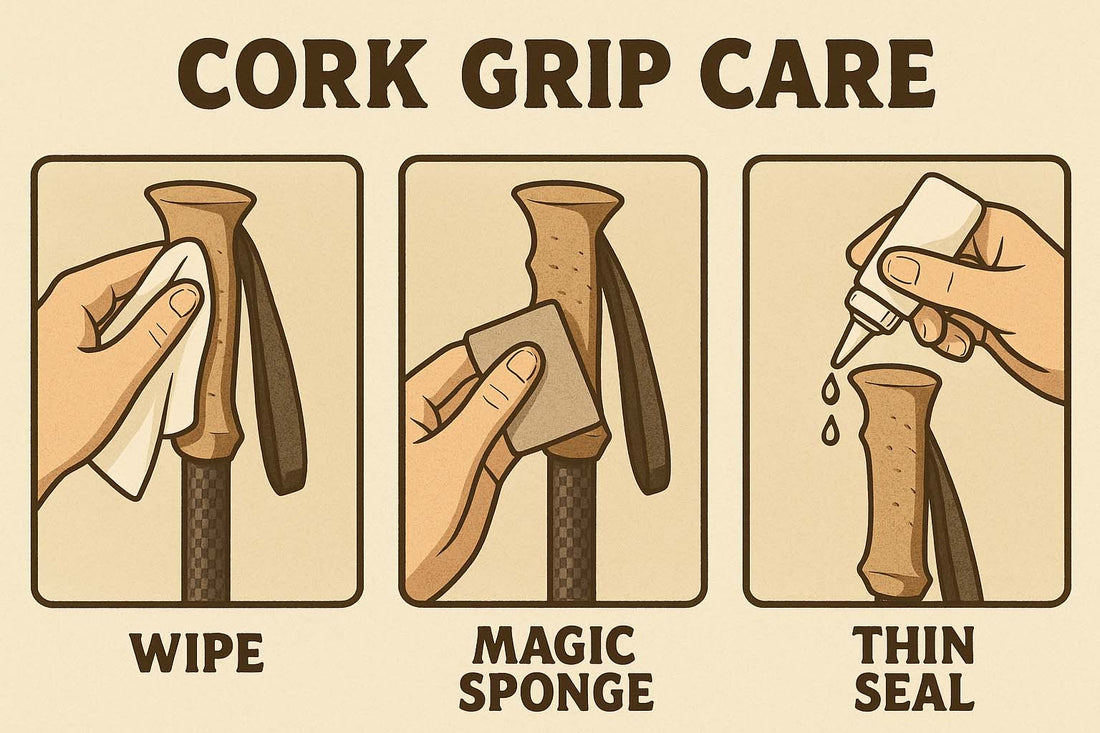
- Essuyez la transpiration et la poussière : passez un chiffon humide le long de la poignée et sous la sangle.
-
Séchage à l'air libre, à l'abri du soleil : disposer les poteaux horizontalement ; éviter les voitures chaudes/les radiateurs.
Cela empêche à lui seul le sel et les impuretés de s'infiltrer dans le liège et les joints de colle.
Le nettoyage en profondeur sécuritaire (mensuel ou au besoin)

1) Lavage au savon
Mélangez quelques gouttes de liquide vaisselle doux dans de l'eau tiède. Trempez un chiffon et frottez délicatement la poignée en faisant tourner la canne. Ne trempez pas la poignée : le liège est poreux ; il faut simplement nettoyer la surface, pas la tremper.
2) Détachez la saleté avec une éponge magique
Humidifiez l'éponge en mélamine, essorez-la presque complètement et frottez légèrement les zones foncées. De petits mouvements doux suffisent ; la mélamine est légèrement abrasive. Rincez l'éponge régulièrement.
3) Détaillez l'ancrage et les rainures de la sangle
Utilisez un coton-tige ou un cure-dent enveloppé dans un chiffon pour nettoyer l'endroit où la sangle rejoint la poignée et les coutures supérieures et inférieures ; le sel adore s'y cacher.
4) Rincer et sécher
Essuyez à l'eau claire, puis séchez en tapotant. Placez les bâtons à la verticale pour que l'humidité s'écoule de la poignée. Laissez-les sécher complètement avant de les sceller ou de les emballer.
Réparations ponctuelles : taches, piqûres et ébréchures
- Zones brillantes/vitrées : polissez très légèrement avec du papier de verre grain 400 à 600. Deux ou trois passages suffisent, il ne s’agit pas de travaux de menuiserie. L’objectif est simplement d’ouvrir légèrement la surface pour qu’elle retrouve son adhérence.
- Puits/cavités : insérez une noisette de mastic de liège dans la cavité, laissez-la prendre, puis lissez avec du papier de verre fin.
- Ébréchures sur les bords : si un morceau se détache, retirez-le, remplissez-le de mastic à liège et lissez une fois sec.
Conseil de pro : mieux vaut en faire moins. Un ponçage excessif enlève de la matière et peut modifier la forme de la poignée.
Faut-il imperméabiliser les poignées en liège ?
Les pêcheurs imperméabilisent souvent le liège pour empêcher la transpiration et la saleté de pénétrer. Le même principe s'applique aux bâtons de randonnée , à condition de choisir des modèles légers .
- Choisissez un vernis fin et transparent pour liège (privilégiez les vernis pour cannes à pêche). Évitez les vernis épais ou les huiles qui rendent le liège plastique ou glissant.
- Appliquez une couche très fine à l'aide d'un chiffon non pelucheux. Laissez sécher complètement.
- Résultat : des poignées légèrement plus résistantes aux taches qui conservent leur adhérence naturelle. Si vous préférez le toucher brut, sautez cette étape et nettoyez-les simplement régulièrement.
Ce qu'il faut éviter (les pièges qui nuisent à l'adhérence)
- Tremper les poignées ou utiliser un tuyau d' arrosage /nettoyeur haute pression
- Solvants agressifs (acétone, bains d'alcool fort) ou pulvérisation excessive de DEET sur la poignée
- Chaleur directe (radiateurs, sèche-cheveux, voitures chaudes)
- Huiles/après-shampooings lourds qui obstruent les pores et rendent glissants
Entretien du bracelet et de la rallonge (puisque vous êtes ici)
- Passez un chiffon savonneux sur la sangle et l' extension en EVA sous la poignée principale ; rincez et laissez sécher à l'air libre.
- Si les sangles dégagent une odeur désagréable après un long voyage, un rinçage rapide avec du vinaigre blanc dilué (puis de l'eau) suffit à éliminer l'odeur.
Liste de vérification pour le rangement saisonnier
- Nettoyez et séchez complètement les poignées.
- Desserrez les sangles pour que le sel ne s'accumule pas dans les plis.
- Repliez les poteaux ; rangez-les dans un endroit frais et sec, à l'abri du soleil direct.
- Évitez de les mettre dans des sacs hermétiques et humides – le liège aime respirer.
Quand remplacer une poignée
- Des fissures profondes que l'on peut plier avec le pouce
- De larges morceaux manquent à l'endroit où repose la paume de la main.
- La poignée tourne sur le manche (l'adhésif a lâché).
Vous pouvez continuer à utiliser la perche si elle est sans danger, mais le confort et le contrôle en pâtissent ; il est temps d’opter pour une nouvelle poignée ou de nouvelles perches.
Découvrez l'équipement que nous utilisons en randonnée.
-
Bâtons de trekking pliables en carbone (3K, poignée en liège) — se replient à 14,6 :
https://freevane.com/products/folding-carbon-trekking-poles-3k-ultra-strong -
Bâtons de trekking télescopiques en carbone (3K, poignée en liège) — 24,8–53,1" micro-réglage facile :
https://freevane.com/products/telescoping-carbon-trekking-poles-3k -
Accessoires (embouts en caoutchouc pour le bitume, paniers pour la boue/le sable et la neige) :
https://freevane.com/collections/trekking-pole-accessories

FAQ
Q1. Mes poignées en liège ont noirci — les ai-je abîmées ?
Non. Le noircissement est normal à cause de la transpiration et de la saleté. Un lavage doux au savon et un rapide passage avec une éponge magique suffisent généralement à les faire disparaître.
Q2. Puis-je utiliser de l'alcool à friction pour désinfecter ?
Un léger nettoyage avec un chiffon imbibé d'alcool isopropylique à 70 % suffit. Ne trempez pas le liège ni l'attache de la sangle.
Q3. Les produits d'étanchéité pour liège rendent-ils les poignées glissantes ?
Les mastics de qualité pour tiges de coupe ne provoquent pas de glissement s'ils sont appliqués en couche très fine . Ce sont les enduits épais ou les huiles qui en sont la cause.
Q4. Le ponçage est-il sans danger ?
Oui, très légèrement avec du papier de verre de grain 400 à 600 pour déglacer ou égaliser le mastic. Un ponçage excessif enlève de la matière et modifie la forme de la poignée.